Marianne Lescher, Principal at Kyrene Traditional Academy, asked the attendees, “can we have equity with excellence or is it trade-off?” To outline, Elaine Jacobs of North Canyon High School gave an overview of the US and its International competitors. Their research in the highest performing countries revealed that students stack up equally in performance, no matter the socio-economic standing, when all systems are in alignment. Lescher pointed to NISL’s “Education Reform Agenda” which gives educators nine building blocks to ensure that all systems (support, development and management of schools) are in alignment, the key to achieving excellence and college or career ready students. “Leadership is part science and part art,” noted Giselle Herrera, Executive Director of Curriculum and Instruction at Tolleson Elementary School District. Herrera explained the importance of equity as a design criterion that should be built into school leadership systems. Making sure that there is support for families and teachers and using tools to assess moral and equitable culture are components needed to achieve “Equity in Action.”
2016 ASBA Conference Communicator
Your place for all the latest news from the 2016 Arizona School Boards Association Annual Conference
Friday, December 16, 2016
Looking to close achievement gap, leaders seek research-based answers
Consolidation shows improved efficiencies
![]() |
| Riley Frei |
Social media apps can help districts relay their message, brand
“What makes social media social is the fact that you can interact with people. Ask questions. Use hashtags,” said Marlys Weaver, Administrator of Communications with Mesa Unified School District. Attendees gathered to learn more about apps as well as four major social media platforms, Facebook, Twitter, Snapchat and Instagram. The session was led through interactive timed discussions, where each table represented a social platform. Concerns from attendees included how to deal with negative comments or reviews on social media and how to better connect and gather feedback from their audiences.
While Heidi Hurst, Supervisor of District Communications with Mesa USD discussed Facebook set-up tutorials with additional template design resources at her table, Adriana Parsons, Director at MET Professional Academy discussed the relevance and learning curve of the Snapchat interface. Zachery Fountain of Dysart USD described apps as a means to make your work stand out on a budget and the importance of making a connection, “not just to parents and students, but to the wider community.”
Collaboration key to students' social, emotional growth
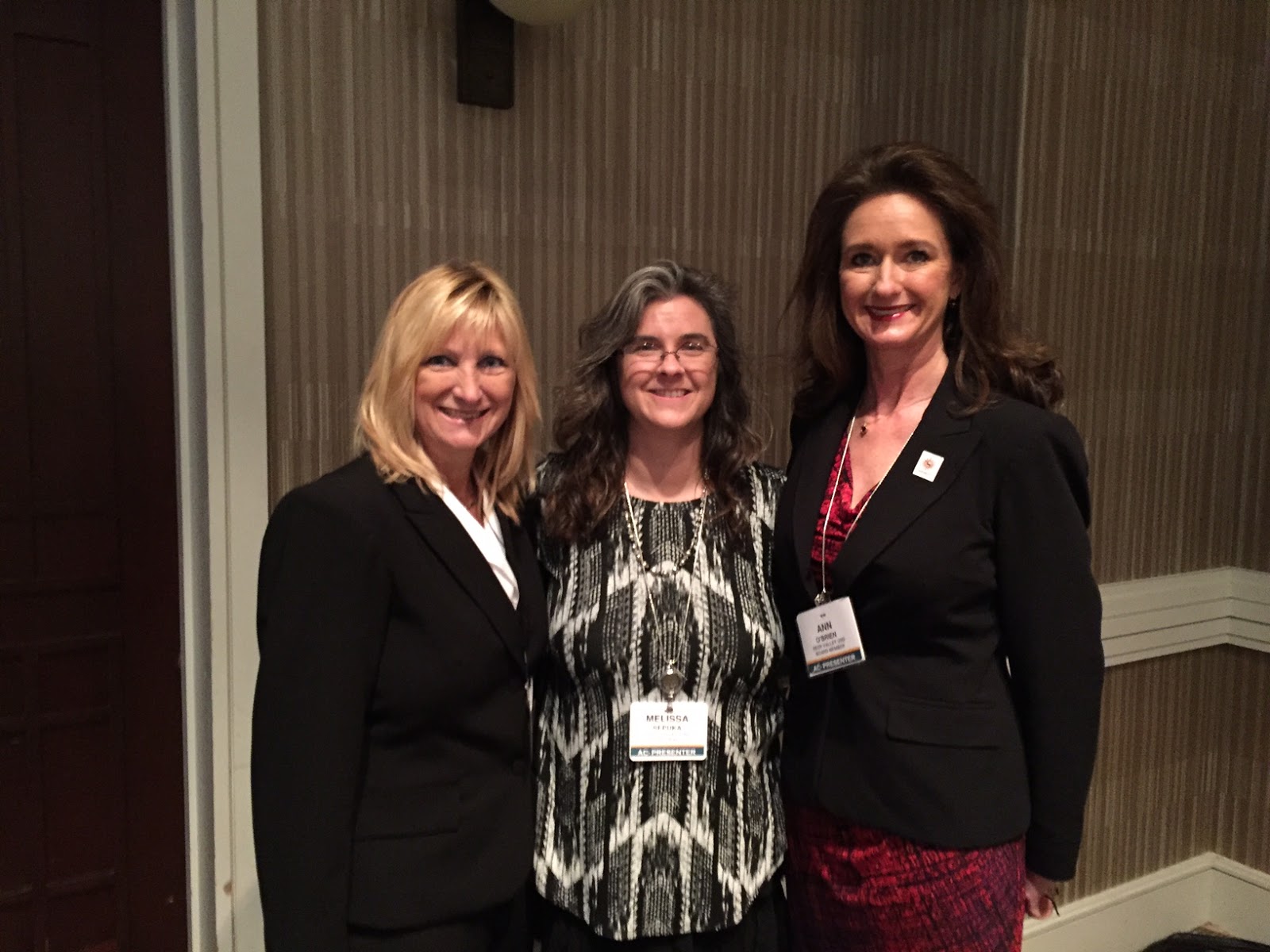
| From Deer Valley Unified School District: Cherryl Paul, Director of Organizational Improvement, Melissa Sepuka, Principal, and Ann O'Brien, governing board member. |
AVID can help close the achievement gap
Dr. Michael Cowan, Superintendent, Mesa Public Schools, Dr. Perry Berry, Superintendent, Queen Creek USD and Kathy Mullery, Connolly Middle School Principal, Tempe ESD, gave an inside look at their respective initiatives to close the gap through AVID - Advancement Through Individual Determination. AVID is in more than 5,600 schools in 44 states. A focus on leadership, instruction, systems and culture brings schoolwide results. And data shows AVID graduates demonstrate greater persistence and success in postsecondary education.
Mesa and Queen Creek are on trajectories to achieve districtwide AVID. The program helps students overcome the traps of poverty and reach their full potential. AVID positively impacts instructional quality through comprehensive professional development and teaches self-management skills that help students be successful. It is an excellent avenue to bring talk into action.
Secret about humans: decision-making isn't logical
Dr. Mike Lee is a self-professed nerd about research on human behavior. The Paradise Valley director of professional development quoted Antonio Damario, saying "decision-making isn't logical, it's emotional," and Madison Avenue knows it. Lee also said if you keep hearing something, you begin to believe it is true. He noted that human beings aren't looking for truth, rather they're looking to persuade others.
An interactive look at preparing STEM teachers
Nancy Perry, Senior Assistant Dean of
Arizona State University, began by asking the important question: how do you
tame the “wicked problem” of recruiting, inducting and retaining middle school
STEM teachers? The answer: human-centered design. In researching for the SEED
grant (Supporting Effective Educator Development) for the Mary Lou Fulton
Teacher’s College, Nancy explained, “one of the things we’ve learned is that we
need to start looking at these problems by empathizing with our end-user – the
middle school math or science teacher.”
Arizona State Assistant Clinical Professor,
Pamela Harris and Senior Research Analyst, Carrie Lloyd broke the session into
interactive discussion by asking each table to share ideas on which characteristics
define a great STEM teacher, and how to recruit and retain these individuals. A
popular topic was engagement – the need for teachers to engage in social
emotional development. The team of researchers found that STEM teachers lack
social emotional training and could be better retained by employers who offer
emotional intelligence classes. The group also found that utilizing a “high
touch recruitment strategy,” where employers touch base once a week and offer
to take new teachers to school visits and social gatherings, has proven successful
in retention. While STEM teachers are often thought of as more logical, Perry
explains the importance of catering to their creative intelligence as well.
Perry notes that somewhere along the way, “we may have forgotten about the
human in the
Subscribe to:
Comments (Atom)